
SeriesLimited
Hive Series
Machined honeycomb geometry with control, articulation, and presence.
View details
Process
Why venting matters in drums, and why the same air-spring logic shows up in loudspeakers.

Details
Overview
Most talk about drum vents is too vague. A vent is not decoration, and it is not just a hole in a shell. It changes how quickly pressure equalizes between the inside of the drum and the room around it.
That makes venting a coupled-air problem: the membrane moves, the cavity compresses, the air finds a path, and the system settles differently than it would in a fully sealed shell.
The same underlying logic shows up in loudspeakers, where the driver, the cabinet air, and the port form a coupled acoustic system.
When a drumhead moves, it is not moving against empty space. It is moving against a volume of air that behaves like a spring. If the cavity is sealed too tightly, that trapped air can stiffen the system and make the drum feel choked or over-controlled.
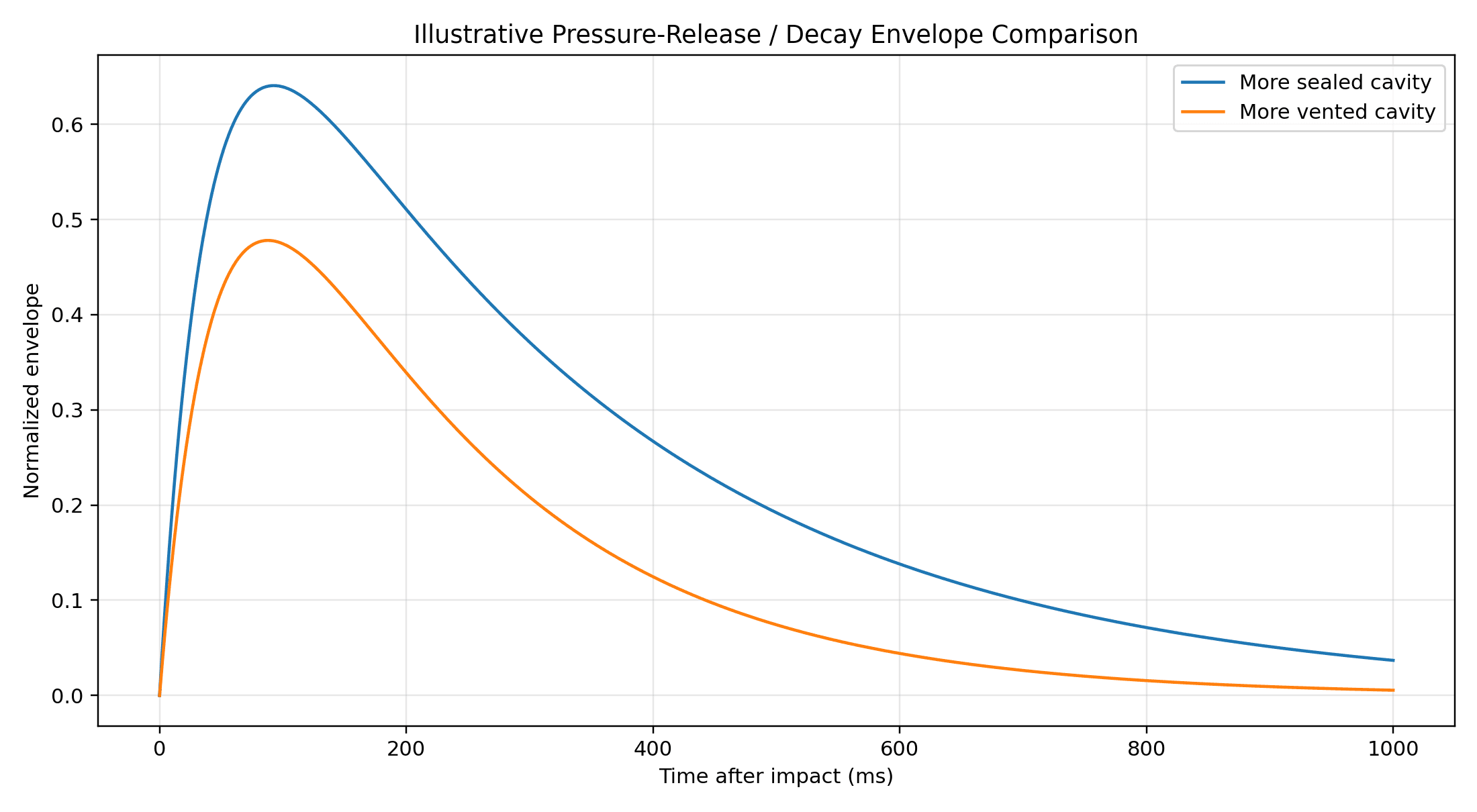
A vent gives that pressure a path to move. The result is not simply louder or quieter. The result is a different time constant for how pressure builds and releases inside the shell.
The cavity behaves like a spring because the enclosed air resists motion and stores pressure energy between strikes.
The vent changes the rate at which that pressure can release.
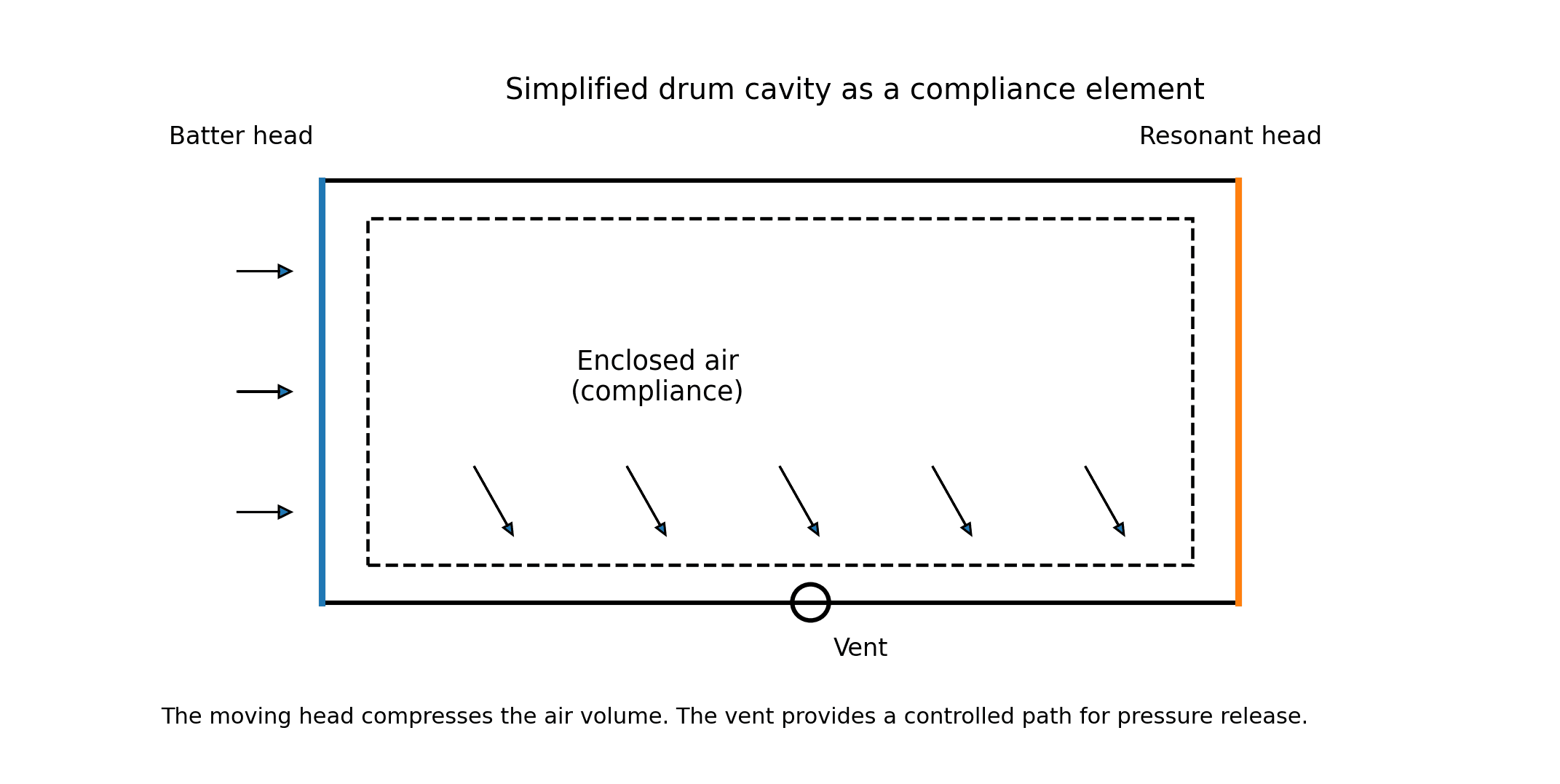
A vent changes how the drum releases stored air energy after impact. That can alter attack shape, sustain, and the feeling of resistance under the stick.
It also changes how strongly the cavity couples the two heads together. In a snare or tom, that coupling affects how much the instrument feels like one system versus two separate membranes with air between them.
A drum vent is not a tuned bass-reflex port. The parallel is not about copying loudspeaker design literally.
It is about recognizing the same acoustic ingredients: a moving membrane, an enclosed compliance, and an opening that changes how the system stores and releases energy.
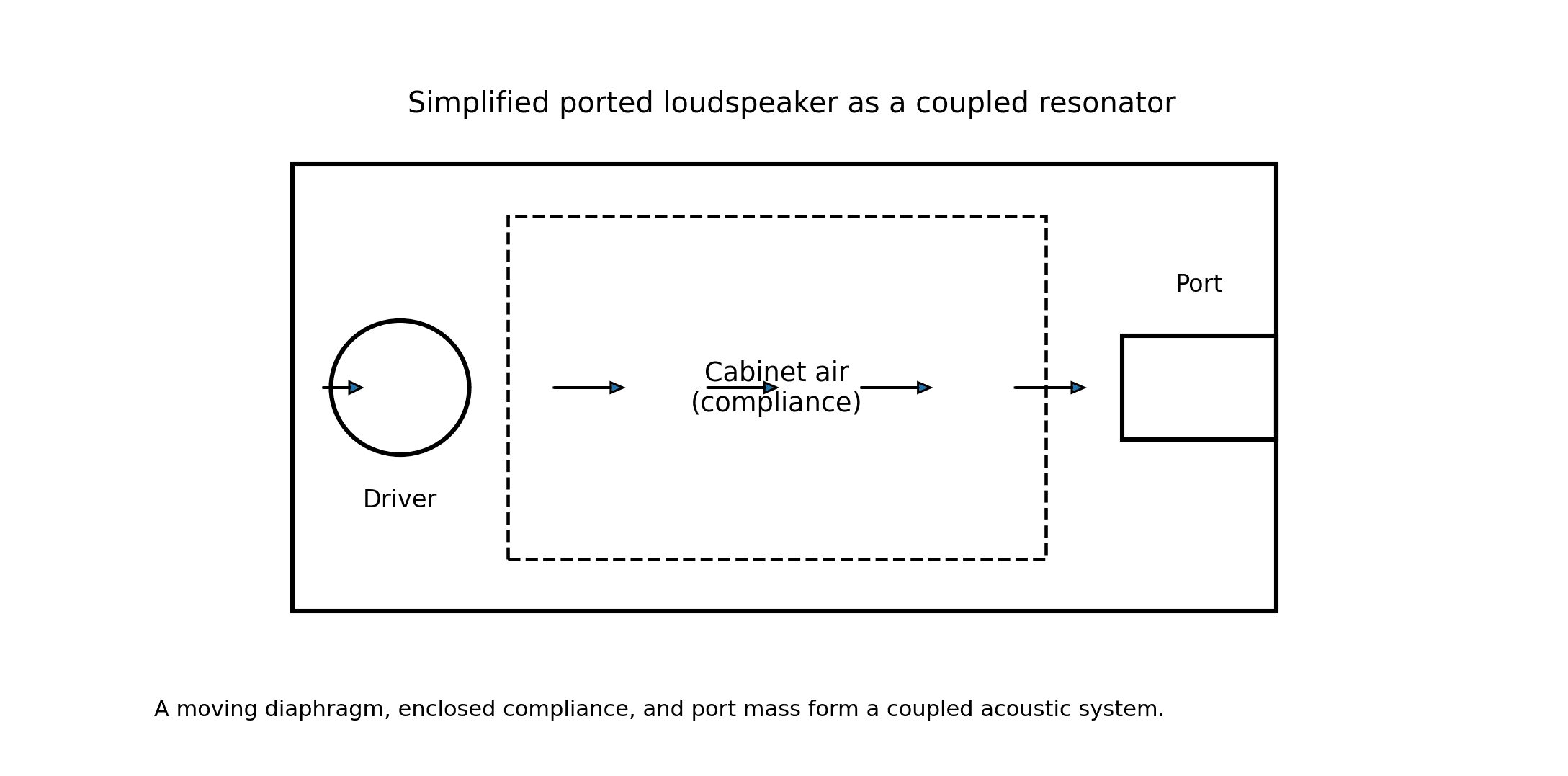
The loudspeaker comparison is useful because it gives names to the moving parts of the problem.
A speaker cabinet is designed to extend or tune low-frequency output. A drum vent is usually not tuned that way. In a drum, the opening is more about pressure management, cavity behavior, and the way the shell breathes under impact.
That distinction matters. The point is not to make a drum behave like a loudspeaker. The point is to notice that both systems are shaped by how air loads a moving membrane.
A larger vent lowers the pressure build-up more aggressively. A smaller one preserves more of the trapped-air behavior. Placement matters too, because the opening changes the symmetry of the cavity and the way pressure moves around the shell.
Shell depth, head tension, bearing edges, and hardware mass all affect how obvious that change feels.
Compare how a more sealed cavity and a more vented cavity behave after impact.
At Robot, venting is not an afterthought. It is one more way to place the air behavior of the drum intentionally.
The design question is not simply whether a vent exists. The question is what kind of pressure relationship the instrument should have with the room, and how that choice supports the feel of the drum as a whole.
The more useful question is how the system stores pressure, how it releases it, and what that does to the way the drum responds.
That is where the drum and the loudspeaker share a useful acoustic vocabulary: compliance, inertance, coupling, radiation, and control.
Related object
A technical look at membrane modes, shell resonances, and why we build lighter, more compliant shells with machined surface features.
An essay on the history, symbolism, and modern uses of asanoha, from textiles and crests to drum shells.