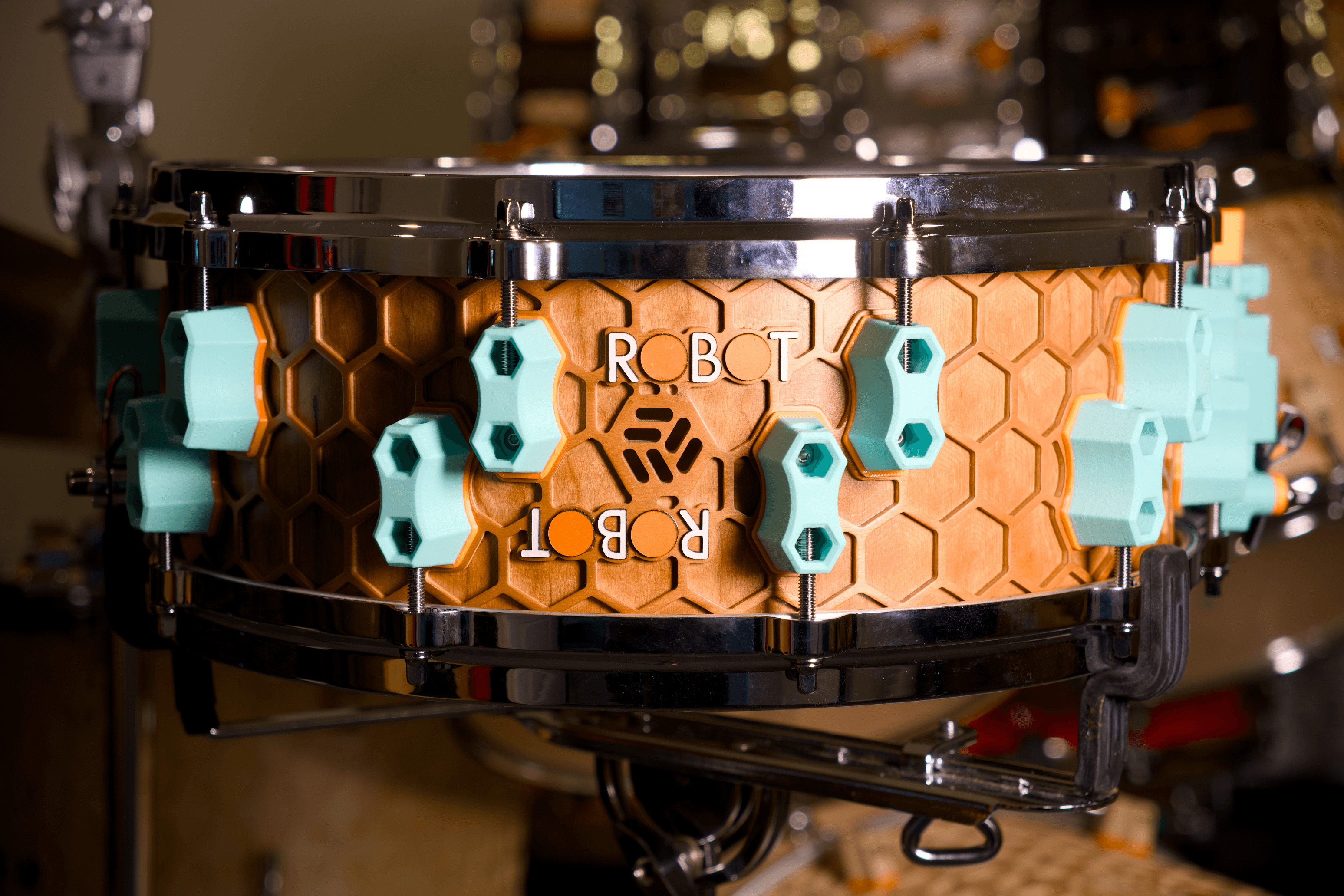
00Series
Hive Series
LimitedMachined honeycomb geometry with control, articulation, and presence.
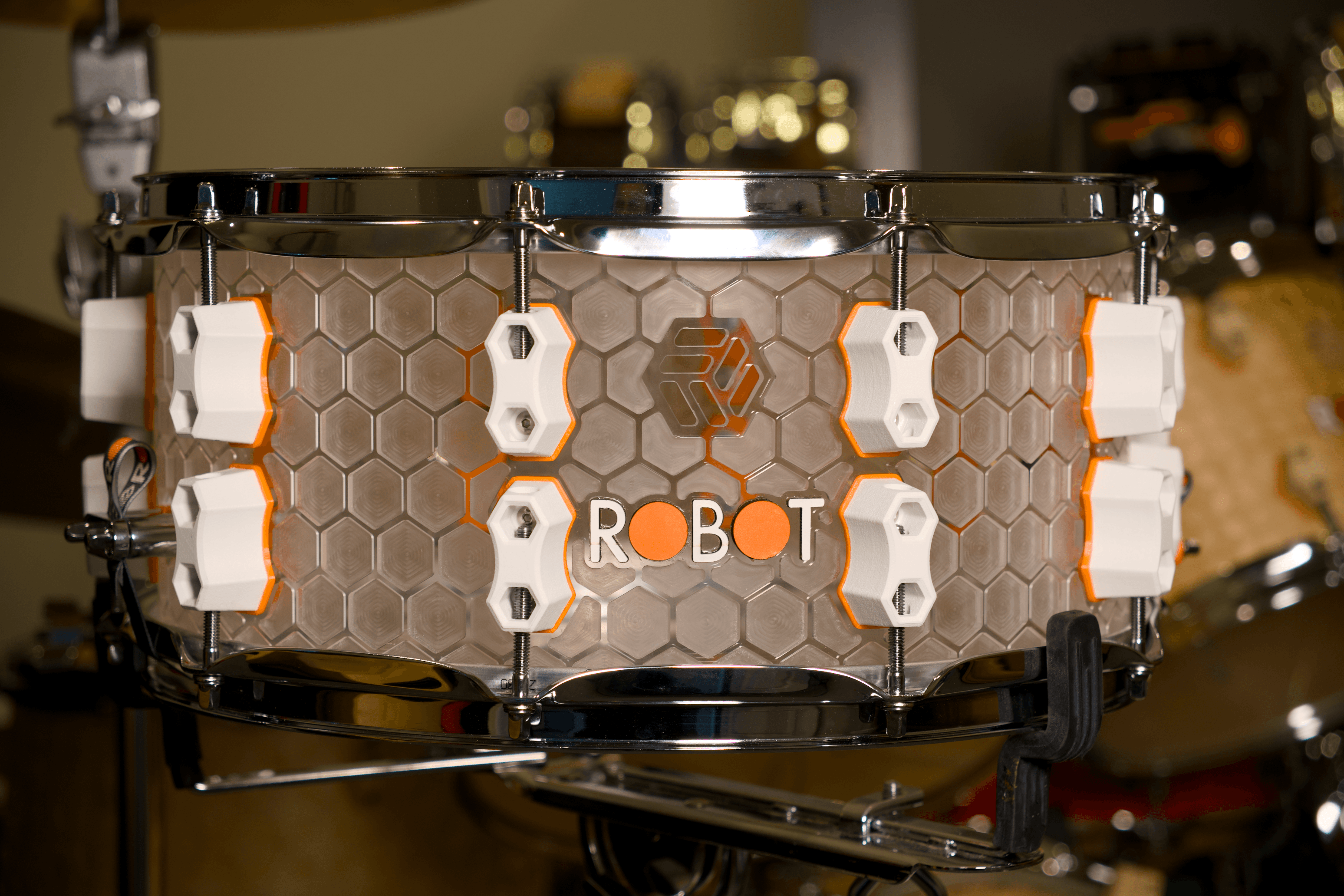
View details
Process
A technical look at membrane modes, shell resonances, and why we build lighter, more compliant shells with machined surface features.
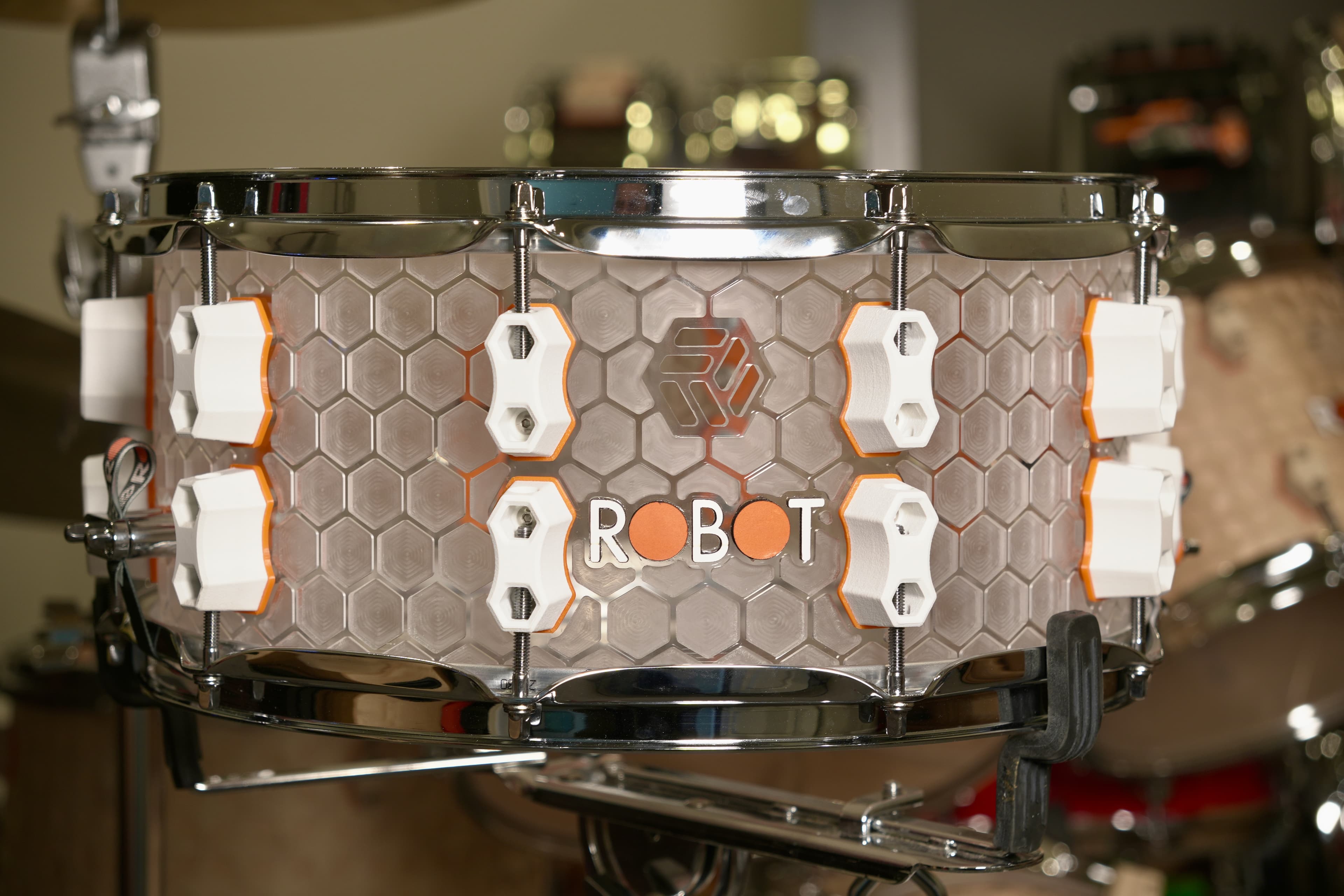
Entry details
Overview
Most descriptions of drums stop too early. A stick hits a head. The head vibrates. The drum makes sound.
That is true, but it leaves out almost everything interesting. A real drum is a coupled system: membranes, enclosed air, shell, hardware, bearing edges, and strike position all working together.
At Robot, that physics matters because it informs design. It is one reason we are interested in shells that are lighter, more compliant, and shaped with machined surface geometry rather than treated as inert containers.
The most obvious resonator in a drum is the head. In the simplest idealization, a drumhead behaves like a stretched circular membrane with a family of vibrational modes, each with its own nodal pattern and frequency.
The lowest mode is the familiar 0,1 mode. Above it come 1,1, 2,1, 0,2, and so on. The important point is that the modal frequencies of an ideal circular membrane are not integer multiples of the fundamental. That is one reason most western drums are heard more as timbre than as strongly pitched instruments.
Figure 1
Show the standard frequency ratios of the lowest membrane modes relative to the fundamental.
That clean membrane picture is only the beginning. Real heads have finite bending stiffness, real tuning is never perfectly uniform, and air loading shifts the frequencies.
Once you add the shell and the stand, you introduce more coupling paths. When a second head is added, the behavior becomes dramatically more complicated. The actual sound of a drum is the result of departures from the ideal just as much as it is the ideal itself.
On a snare or tom, the batter and resonant heads interact through the enclosed air volume. In the low modes especially, the two heads are not independent resonators. They become a coupled system.
A useful first approximation is to think of the two heads as two spring-mass systems connected by an additional coupling spring. In that picture, one uncoupled resonance splits into two nearby resonances: one where the heads move more in phase, and one where they move more out of phase.
Figure 2
Show how one uncoupled resonance splits into two as coupling increases.
The shell is not the primary radiator in the same way the head is. But it is not acoustically irrelevant either. It has its own vibrational modes, and those modes can sit near, between, or far from the frequency region where the heads are active.
If shell resonances are pushed high enough, the shell behaves more like a rigid boundary over the range where the head is doing most of the work. If shell resonances move down into a region where they can interact more strongly with the head and the enclosed air, the shell becomes more dynamically involved.
For a cylindrical shell, resonance frequencies depend on geometry and on the material's stiffness-to-mass behavior. In practical terms, shell-mode frequencies rise when you increase thickness and stiffness, and they fall when you reduce them.
Radius matters strongly too: larger shells tend to move those shell resonances downward. Shell design is therefore a modal-placement problem: where do the shell's own resonances sit relative to the important head modes, and how much do they participate?
Figure 3
Show the simplified trend that shell-mode frequency rises as thickness increases, with material and diameter held fixed.
A shell that is too rigid over the whole operating range can become acoustically passive. It holds the heads in place, but contributes less to the instrument as a coupled vibrating object.
A shell with lower effective bending stiffness and lower mass can bring its own resonant behavior closer to the part of the spectrum where the drum is alive. That can change feel, attack shape, overtone behavior, and the way the instrument reacts under different tunings and strike intensities.
When we machine surface geometry into a shell, we are not thinking only about aesthetics. Surface geometry changes the local distribution of mass and stiffness, changes bending behavior, and can spread, break up, or retain higher-frequency energy.
That is one reason we are interested in it as a real design tool. A machined shell is not just decorated; it is mechanically re-authored.
That question is too blunt to be useful. A better question is where the shell modes are, how strongly they participate, and what that does to the behavior of the whole drum.
That is a question about coupling, not dogma. It is also a much more productive way to think about drum design.
At Robot, we are interested in shells that do more than passively support a membrane. We want the shell to be part of the instrument's response.
That leads us toward lower mass where it makes sense, lower effective stiffness where it improves participation, structural features that deliberately move or reshape shell resonances, machined surface geometry as a mechanical tool, and design decisions informed by mode placement rather than only tradition.
It is a coupled vibrational system with multiple resonators interacting at once.
Once you start looking at it that way, a lot of familiar drum language becomes easier to decode. So do design decisions.
The real question is not whether one material is better, or whether a heavier shell is always more focused, or whether a lighter shell is always more resonant.
The real question is where the modes are, how they couple, and what kind of instrument you want that physics to create.
Next
Open the related object or return to Studio.
More from Studio
A closer look at how surface structure becomes part of the product language.
How machined honeycomb geometry became part of the instrument, not a surface treatment.